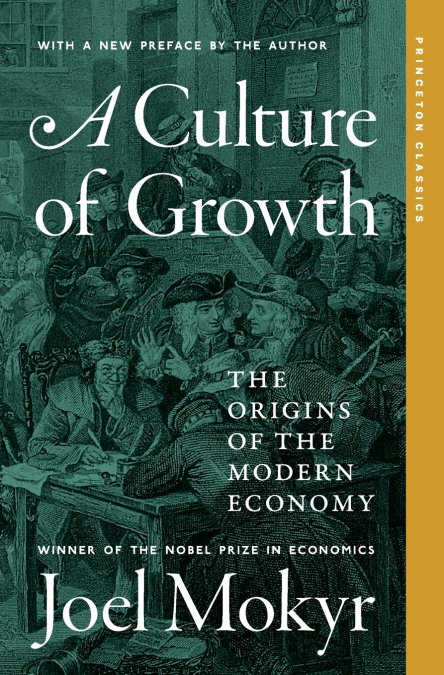
A Culture of Growth

A Culture of Growth

Joel Mokyr

26,55 €
IVA incluido
Disponible
Editorial:
Princeton University Press
Año de edición:
2026
Materia
Historia de la economía
ISBN:
9780691292519
26,55 €
IVA incluido
Disponible
Añadir a favoritos

From Nobel Prize–winning economist Joel Mokyr, a revealing look at why Enlightenment culture sparked the Industrial RevolutionDuring the late eighteenth century, innovations in Europe triggered the Industrial Revolution and the sustained economic progress that spread across the globe. While much has been made of the details of the Industrial Revolution, what remains a mystery is why it took place at all. Why did this revolution begin in the West and not elsewhere, and why did it continue, leading to today’s unprecedented prosperity? In this groundbreaking book, celebrated economic historian Joel Mokyr argues that a culture of growth specific to early modern Europe and the European Enlightenment laid the foundations for the scientific advances and pioneering inventions that would instigate explosive technological and economic development. Bringing together economics, the history of science and technology, and models of cultural evolution, Mokyr demonstrates that culture—the beliefs, values, and preferences in society that are capable of changing behavior—was a deciding factor in societal transformations.Mokyr looks at the period 1500–1700 to show that a politically fragmented Europe fostered a competitive "market for ideas" and a willingness to investigate the secrets of nature. At the same time, a transnational community of brilliant thinkers known as the “Republic of Letters” freely circulated and distributed ideas and writings. This political fragmentation and the supportive intellectual environment explain how the Industrial Revolution happened in Europe but not China, despite similar levels of technology and intellectual activity. In Europe, heterodox and creative thinkers could find sanctuary in other countries and spread their thinking across borders. In contrast, China’s version of the Enlightenment remained controlled by the ruling elite.Combining ideas from economics and cultural evolution, A Culture of Growth provides startling reasons for why the foundations of our modern economy were laid in the mere two centuries between Columbus and Newton.
Artículos relacionados

  • Foreign Banks and Global Finance in Modern China
    Ghassan Moazzin
    ...
    Disponible

    43,87 €

  • F.U.B.A.R. From Inflation to Hyperinflation
    Pawlo Lawriw
    Inflation and hyperinflation results in F.U.B.A.R on an epic scale. It can cause social and economic collapse and war and in short, change history- for the worse. If you are worried about inflation, who is not, then F.U.B.A.R. (F****d Up Beyond All Recognition) FROM INFLATION TO HYPERINFLATION is a work that you need to read.Some observers now wonder as society suffers from hig...
    Disponible

    18,47 €

  • Scarce and Valuable Economical Tracts
    John Ramsay McCulloch
    This volume, Scarce and Valuable Economical Tracts, was edited by John Ramsay McCulloch and originally published in 1859. It contains essays on political economy written by: Nicholas Barbon, Daniel Defoe, Henry Elking, Thomas Wise, Benjamin Franklin, Anne Robert Jacques Turgot, James Anderson, Alexander Schomberg, Joseph Townsend, Edmund Burke, and Archibald Bell.In her entry o...
    Disponible

    17,77 €

  • The Winding Road to the Welfare State
    George R. Boyer
    How did Britain transform itself from a nation of workhouses to one that became a model for the modern welfare state? The Winding Road to the Welfare State investigates the evolution of living standards and welfare policies in Britain from the 1830s to 1950 and provides insights into how British working-class households coped with economic insecurity. George Boyer examines the ...
    Disponible

    46,52 €

  • Joseph Alois Schumpeter
    Wolfgang F. Stolper
    In this major scholarly study of the life of Joseph A. Schumpeter, one of the great intellectual figures of the twentieth century, the distinguished economist Wolfgang Stolper delves into the mind of his former teacher, exploring the development of his ideas and, especially, their influence on politics and public policy. After reflecting briefly on Schumpeter the man, Stolper e...
    Disponible

    107,85 €

  • An Economic History of the Iberian Peninsula, 700-2000
    ...

Otros libros del autor

  • The British Industrial Revolution
    Joel Mokyr
    The Industrial Revolution remains a defining moment in the economic history of the modern world. But what kind and how much of a revolution was it? And what kind of ?moment? could it have been? These are just some of the larger questions among the many that economic historians continue to debate. Addressing the various interpretations and assumptions that have been attached to ...
  • A Culture of Growth
    Joel Mokyr
    From Nobel Prize–winning economist Joel Mokyr, a revealing look at why Enlightenment culture sparked the Industrial RevolutionDuring the late eighteenth century, innovations in Europe triggered the Industrial Revolution and the sustained economic progress that spread across the globe. While much has been made of the details of the Industrial Revolution, what remains a mystery i...
    Disponible

    31,47 €

  • The Economics of the Industrial Revolution (Routledge Revivals)
    Joel Mokyr
    First published in 1985, this collection contains ten key essays written by leading economists on the subject of the Industrial Revloution. Among the questions discussed are the causes for the pre-eminence of Britian, the roles of the inputs for growth (capital, labor, technical progress), the importance of demand factors, the relation between agricultural progress and the Indu...
    Disponible

    92,02 €

  • The Economics of the Industrial Revolution (Routledge Revivals)
    Joel Mokyr
    First published in 1985, this collection contains ten key essays written by leading economists on the subject of the Industrial Revloution. Among the questions discussed are the causes for the pre-eminence of Britian, the roles of the inputs for growth (capital, labor, technical progress), the importance of demand factors, the relation between agricultural progress and the Indu...
  • Why Ireland Starved
    Joel Mokyr
    Technical changes in the first half of the nineteenth century led to unprecedented economic growth and capital formation throughout Western Europe; and yet Ireland hardly participated in this process at all. While the Northern Atlantic Economy prospered, the Great Irish Famine of 1845-50 killed a million and a half people and caused hundreds of thousands to flee the country. Wh...
    Disponible

    91,73 €

  • Why Ireland Starved
    Joel Mokyr
    Technical changes in the first half of the nineteenth century led to unprecedented economic growth and capital formation throughout Western Europe; and yet Ireland hardly participated in this process at all. While the Northern Atlantic Economy prospered, the Great Irish Famine of 1845-50 killed a million and a half people and caused hundreds of thousands to flee the country. Wh...