Inicio > Humanidades > Filosofía > Ética y filosofía moral > A New Epoch of Enlightenment - Volume I
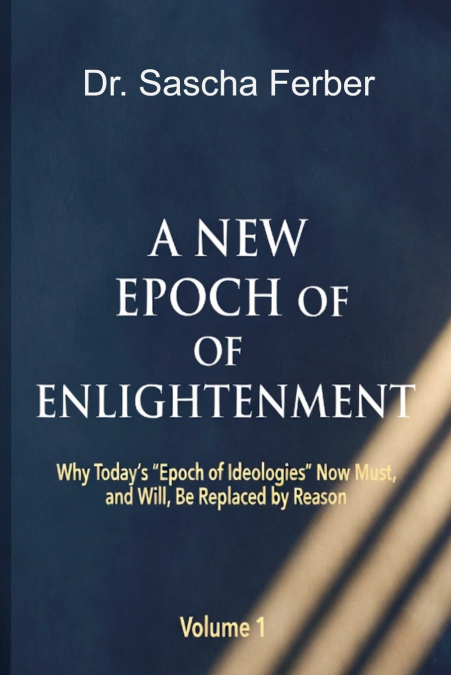
A New Epoch of Enlightenment - Volume I

A New Epoch of Enlightenment - Volume I

Sascha Ferber

25,73 €
IVA incluido
Disponible
Editorial:
Dr. Sascha Ferber
Año de edición:
2026
Materia
Ética y filosofía moral
ISBN:
9798235892538
25,73 €
IVA incluido
Disponible
Añadir a favoritos

Why Today’s 'Epoch of Ideologies' Now Must, and Will, Be Replaced by Reason. We live in an Epoch of Ideologies. Feelings, narratives, and the politics of interest have displaced reason and the careful testing of premises. What began as postmodernism’s critical impulse has hardened into structures of thought that immunize themselves against evidence, moralize disagreement, treat the speaker’s identity as decisive, invoke permanent emergency, and defer every promise to an unfalsifiable future. The consequences are visible across universities that abandon truth-seeking, sciences steered by agenda, media and politics detached from reality, and economies that concentrate power while eroding the trust on which free exchange depends. At the root lies the loss of stable premises - secure, rationally grounded starting points that correspond to reality. Without them no science, polity, economy, or individual life can endure.A New Epoch of Enlightenment, Volume 1 diagnoses this condition with precision and recovers the path forward. Drawing on the European Enlightenment of the eighteenth century - Kant’s call to maturity, Lessing’s precision, Lichtenberg’s sobriety, and above all the systematically underestimated Christoph Martin Wieland - Dr. Sascha Ferber shows that the foundations still exist. Wieland, once more famous than Goethe and Schiller and author of nearly twenty thousand pages, emerges as the actual founder of a Wielandian Classic: a programme of being 'one and whole,' of the Philosophy of the Graces, and of a humane anthropology crystallized with unique density in the poem Musarion. There happiness is a cultivated inner state rather than an external event; virtue arises from taste and insight rather than compulsion; communities thrive through mutual strengthening rather than extraction.The book sets out concrete building blocks of renewal: the six formal marks by which any ideology may be recognized, independent of political direction; genuine science that begins with questions rather than agendas; an economic paradigm of mutuality that affirms self-interest without absolutizing it - 'caring and sharing' as lived by entrepreneurs such as Dave Hodgson and conceptualized as the Economics of Mutuality - rejecting both unbridled extraction and state socialism; political principles centered on checks and balances and the vigorous defence of freedom of speech and the press; and a practical path from analysis to action. Readers are offered seven questions that slow the moment of assent and concrete steps across five spheres of everyday life: thinking, language, relationships, profession, and community. Neither manifesto nor narrow academic monograph, this philosophical work of nonfiction is an invitation to individual maturity - the courage to use one’s own understanding, completed by Wieland’s lived, graceful humanity. The light of the Enlightenment has not vanished. It still exists in the ideas, the works, and the spirit of the eighteenth century. It must be rekindled by those who decide to think clearly, speak truthfully, act with integrity, and strengthen the people around them. The foundations are still there. The decision is ours.

Artículos relacionados

  • Ka Ab Ba Building The Lighted Temple
    Dr Terri R. Nelson / Dr Terri RNelson
    The book KaAbBa Building The Lighted Temple/Metaphysical Keys to the Tree of Life draws a circle that is inclusive of the Afrikan origin of the Ancient Kemetic/Egyptian wisdom. It reveals the undeniable root and link of Ancient Africa to all the religious systems that would develop worldwide. This book is explosive in its power to convey the meaning of KaAbBa, the Medu Neter  (...
    Disponible

    37,41 €

  • Technoethics and the Evolving Knowledge Society
    Rocci Luppicini
    Recently, there has been a major push to rediscover the ethical dimension of technology across the sciences, social sciences, and humanities. Technoethics and the Evolving Knowledge Society: Ethical Issues in Technological Design, Research, Development, and Innovation examines human processes and practices connected to technology embedded within social, political, and moral sph...
  • Kant
    Immanuel Kant
    Kant’s Groundwork of the Metaphysics of Morals is one of the most important works in modern moral philosophy. It belongs beside Plato, Aristotle, Machiavelli, and Hobbes. Here Kant sets out to articulate and defend the Categorical Imperative - the fundamental principle that underlies moral reasoning - and to lay the foundation for a comprehensive account of justice and human vi...
  • On the Duty of Civil Disobedience
    HENRY DAVID THOREAU
    Civil Disobedience argues that citizens should not permit their governments to overrule their consciences, and that they have a duty to avoid allowing their acquiescence to enable the government to make them the agents of injustice. Thoreau was motivated in part by his disgust with slavery and the Mexican-American War, but the sentiments he expresses here are just as pertinent ...
  • Beyond Good and Evil
    Friedrich Nietzsche
    Nietzsche, though primarily a philosopher, wrote widely on art, philology, history, religion, tragedy, culture, and science.  In 1886, at the height of his powers, he published Beyond Good and Evil.  Here he examines much of the best of human thought--dogmatic philosophy, Judeo-Christian morality, science and democracy – and finds it lacking.  Rejecting “slave-morality” he pres...
  • Beyond Good and Evil
    Friedrich Nietzsche
    Nietzsche, though primarily a philosopher, wrote widely on art, philology, history, religion, tragedy, culture, and science.  In 1886, at the height of his powers, he published Beyond Good and Evil.  Here he examines much of the best of human thought--dogmatic philosophy, Judeo-Christian morality, science and democracy – and finds it lacking.  Rejecting “slave-morality” he pres...
    Disponible

    9,99 €

Otros libros del autor

  • Ehrlichkeit, Fairness und Korruption in der europäischen Geschichte, Band 1 - 2. erweiterte Auflage
    Sascha Ferber
    Warum Gesellschaften aufblühen oder verfallen, entscheidet sich nicht zuerst an Lage, Bevölkerung oder Rohstoffen. Es entscheidet sich an einer Kraft, die oft zur Moralfloskel oder zur Compliance-Frage verengt wird: an Ehrlichkeit, Fairness und Korruption. Dr. Sascha Ferber zeigt in diesem ersten Band einer zweibändigen Untersuchung, dass diese Größen historische Kräfte ersten ...
    Disponible

    89,28 €

  • Honesty, Fairness and Corruption in the European History - Volume II
    Sascha Ferber
    What if the scandals that define our age - Wirecard, Qatargate, FTX, Cum-Ex - are not mere failures of individuals, but the modern face of forces that have shaped European history for two millennia?In this compelling second volume, Dr. Sascha Ferber turns from the deep historical diagnosis of Volume I to the living pathologies of the present. Through rigorous root-cause analysi...
    Disponible

    61,61 €

  • Ehrlichkeit, Fairness und Korruption in der europäischen Geschichte - Band II
    Sascha Ferber
    In einer Zeit tiefgreifender Vertrauenskrisen in Wirtschaft, Politik und gesellschaftlichen Institutionen legt Dr. Sascha Ferber mit dem zweiten Band seines mehrbändigen Werkes 'Ehrlichkeit, Fairness und Korruption in der europäischen Geschichte' eine wissenschaftlich fundierte und programmatisch weitreichende Diagnose der Pathologien der Gegenwart vor. Während Band I die histo...
    Disponible

    66,52 €

  • Ehrlichkeit, Fairness und Korruption - Band 1 (Academic Cover Variant)
    Sascha Ferber
    Warum blühen manche Gesellschaften auf, während andere verfallen? Diese uralte Frage hat in unserer Zeit eine neue, bedrängende Dringlichkeit gewonnen. In einer Epoche von Finanzkrisen, Korruptionsskandalen und institutioneller Erosion zeigt sich mit erschreckender Klarheit: Nicht Geographie, Ressourcen oder Technologie entscheiden letztlich über Aufstieg und Niedergang - sonde...
    Disponible

    60,15 €

  • Ehrlichkeit, Fairness und Korruption in der europäischen Geschichte
    Sascha Ferber
    Warum blühen manche Gesellschaften auf, während andere verfallen? Diese uralte Frage hat in unserer Zeit eine neue, bedrängende Dringlichkeit gewonnen. In einer Epoche von Finanzkrisen, Korruptionsskandalen und institutioneller Erosion zeigt sich mit erschreckender Klarheit: Nicht Geographie, Ressourcen oder Technologie entscheiden letztlich über Aufstieg und Niedergang - sonde...
    Disponible

    56,70 €

  • Eine neue Epoche der Aufklärung
    Sascha Ferber
    Wir leben in einer Epoche der Ideologien. Wo einst die Aufklärung des 18. Jahrhunderts Vernunft, Freiheit und Menschlichkeit ins Zentrum stellte, regieren heute Narrative, emotionale Appelle und verborgene Interessen. Universitäten, Medien und Politik scheinen von stabilen Prämissen abgeschnitten - mit verheerenden Konsequenzen für Wahrheit, Vertrauen und das gelingende Leben. ...
    Disponible

    40,85 €