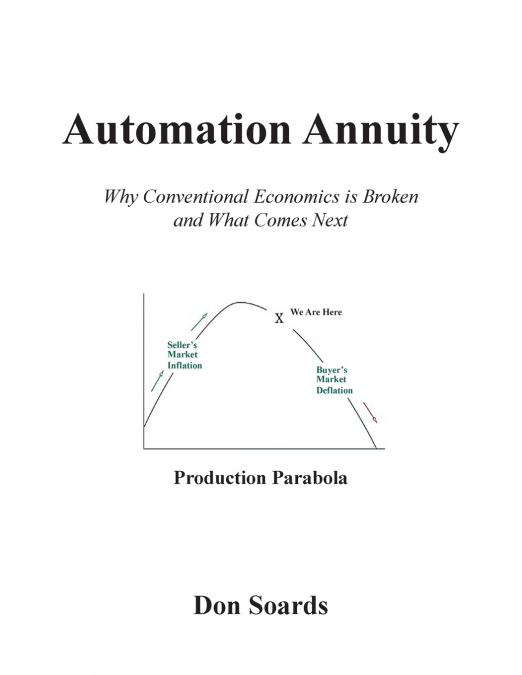
Automation Annuity

Automation Annuity

Don Soards

33,32 €
IVA incluido
Disponible
Editorial:
BookLocker.com Inc
Año de edición:
2026
Materia
Macroeconomía
ISBN:
9781961268920
33,32 €
IVA incluido
Disponible
Añadir a favoritos

What happens when machines can produce more goods and services while employing fewer people to produce them?Automation has delivered extraordinary increases in productivity, but it also creates a problem conventional economics has not solved: machines do not earn wages, buy houses, raise families, or provide the consumer demand needed to purchase what an increasingly automated economy can produce.In Automation Annuity, Don Soards argues that the United States has undergone a fundamental economic transition from the Seller’s Market that dominated much of the twentieth century to a new Buyer’s Market. In the old economy, production capacity was often the limiting factor. In the new economy, automation increasingly makes consumer purchasing power the limiting factor.Soards examines changes in inflation, government debt, wages, employment, consumer demand, and other economic indicators to make the case that many familiar economic assumptions were developed for conditions that no longer exist. Policies designed to restrain an economy suffering from inadequate production can produce very different results when the underlying problem is inadequate consumer demand.The book then presents the Automation Annuity, a new approach to replacing purchasing power lost as automation replaces human labor. Rather than funding a conventional universal basic income through increased taxation or government borrowing, the proposal introduces Progress Dollars into the economy as productive capacity expands. Increases would be gradual and subject to economic safeguards intended to prevent demand from exceeding the economy’s ability to produce.Automation Annuity challenges readers to reconsider some of the most basic assumptions about inflation, money, employment, government debt, and economic growth. It also asks a larger question: if technology gives society the ability to produce abundance with less human labor, can our economic system evolve so that consumers retain the purchasing power necessary to share in that abundance?This book is for readers interested in automation, artificial intelligence, economics, monetary policy, the future of work, universal basic income, and the economic consequences of technological change.
Artículos relacionados

  • Introduction to Dynamic Macroeconomic General Equilibrium Models
    José Luis Torres Chacon
    This book offers an introductory step-by-step course in Dynamic Stochastic General Equilibrium modelling. Modern macroeconomic analysis is increasingly concerned with the construction, calibration and/or estimation and simulation of Dynamic General Equilibrium (DGE) models. The book is intended for graduate students as an introductory course to DGE modelling and for those econo...
    Disponible

    61,40 €

  • International Education and the Next-Generation Workforce
    Wei Wang
    Education is the first stage in developing a viable, dynamic, and long-lived global economy. Unfortunately, in times of economic hardship, educational programs, teacher salaries, and extracurricular opportunities are often the first to be cut. International Education and the Next-Generation Workforce: Competition in the Global Economy presents a detailed discussion of present e...
  • Macroeconomic Policies of Developed Democracies
    Robert J Franzese Jr
    ...
  • End Of The Road
    Louis Holder
    This book is about the mismanagement of Western economies in pursuit of political power, which resulting devastation will have to be borne by future generations. The book establishes that postponement is no longer doable and lays out the hard choices ahead causing much misery and agony.Although not fully recognized because of masking by asset bubbles, which are spun/sold as in...
  • The Darwin Economy
    Robert H. Frank
    What Charles Darwin can teach us about building a fairer societyWho was the greater economist-Adam Smith or Charles Darwin? The question seems absurd. Darwin, after all, was a naturalist, not an economist. But Robert Frank, New York Times economics columnist and best-selling author of The Economic Naturalist, predicts that within the next century Darwin will unseat Smith as the...
    Disponible

    19,81 €

  • Myth and Measurement
    Alan B. Krueger / David Card
    From David Card, winner of the Nobel Prize in Economics, and Alan Krueger, a provocative challenge to conventional wisdom about the minimum wageDavid Card and Alan B. Krueger have already made national news with their pathbreaking research on the minimum wage. Here they present a powerful new challenge to the conventional view that higher minimum wages reduce jobs for low-wage ...
    Disponible

    40,01 €

Otros libros del autor

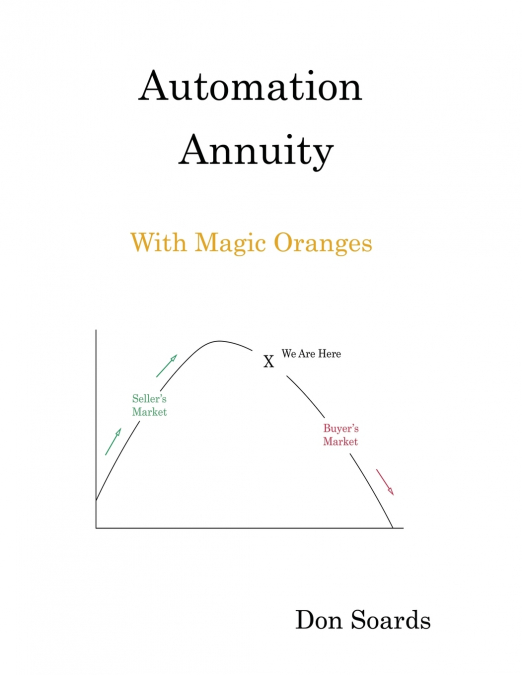
  • Automation Annuity With Magic Oranges
    Don Soards
    Automation Annuity with Magic Oranges presents a visionary economic response to the realities of automation. As machines take over more work and traditional wages disappear, economies shift into a dangerous deflationary cycle-what author Don Soards calls the 'buyer’s market' side of the production parabola.The book introduces the Automation Annuity-an innovative income suppleme...
    Disponible

    32,27 €

  • START-UP Universal Basic Income
    Don Soards
    We are concerned about too many human workers being replaced by machines. We should be. The harm we face goes far beyond the trauma faced by individuals who have lost their jobs to machines over past centuries. We are moving deeper into a condition of 'Who do these corporations think is going to buy their stuff after they lay us all off?'. Our economy is getting smaller.Fortuna...
    Disponible

    12,89 €

  • MAXIMUM UBI
    Don Soards
    We are concerned about too many human workers being replaced by machines. We should be. The harm we face goes far beyond the trauma faced by individuals who have lost their jobs to machines over past centuries. We are moving deeper into a condition of 'Who do these corporations think is going to buy their stuff after they lay us all off?'. Our economy is getting smaller.Fortuna...
    Disponible

    42,70 €

  • Progress Dollars From The Production Parabola
    Don Soards
    Since the industrial revolution started in 1800, machines have been taking people’s jobs. For the first two hundred years we prospered from the increasing efficiency. However, in the year 2000, we reached a tipping point where the new technology has taken so many jobs that we can no longer afford to buy all that we can produce. By the year 2006 our gross domestic product per pe...
    Disponible

    28,22 €

  • Progress Dollars From The Production Parabola
    Don Soards
    Since the industrial revolution started in 1800, machines have been taking people’s jobs. For the first two hundred years we prospered from the increasing efficiency. However, in the year 2000, we reached a tipping point where the new technology has taken so many jobs that we can no longer afford to buy all that we can produce. By the year 2006 our gross domestic product per pe...