Biomedical Engineering

Biomedical Engineering

Martin Foster

17,23 €
IVA incluido
Disponible
Editorial:
PublishDrive
Año de edición:
2026
Materia
Medicina preclínica: ciencias básicas
ISBN:
9798900421315
17,23 €
IVA incluido
Disponible
Añadir a favoritos

Biomedical engineering is what happens when engineers point their tools at the human body. This introduction gives you a working map of the field: what it covers, how the pieces fit together, and where the hard problems still sit. Nine chapters run in order, each building on the one before, so you can read straight through or jump to the topic you need. The biology gets explained in terms an engineer already thinks in, using forces, signals, materials, and systems, and no advanced degree is assumed anywhere in the book. The chapters cover: - What people in the field actually do for a living, the subfields they work in, and how the design process changes when a living patient is part of the system - Human anatomy for engineers: the heart as a pump, bone and muscle as structure, nerves as signal carriers, lungs as gas exchangers, and the cell as the unit everything is built from - Metals, ceramics, and polymers used in implants, plus the foreign body response and why biocompatibility depends on the job a material does rather than the material itself - Biomechanics, including gait analysis, joint reaction forces, stress and strain in tissue, blood flow through vessels, and hip and knee designs built to survive decades of loading - Biopotential measurement, sensor types, noise reduction, and the design constraints on anything worn on the body or implanted inside it - The physics behind X-ray, CT, MRI, ultrasound, and PET, along with the reconstruction algorithms that turn raw detector data into an image a radiologist can read - ECG and EEG analysis, filtering methods for messy physiological data, and machine learning applied to signal classification - Stem cells, scaffold fabrication, bioreactors, 3D bioprinting, organ-on-a-chip systems, and skin regeneration, with a straight account of what already helps patients and what remains years away - FDA approval pathways, device classification, risk management, clinical trials, patents, and the ethical rules governing research on human subjects Written for readers who want the whole picture before going deeper: - Students weighing a degree in the discipline or applying to programs - Nurses, technicians, and clinicians who want to understand the machines they use every shift - Mechanical, electrical, and materials engineers considering a move into medical devices - Anyone curious about how a cochlear implant or an artificial hip really works Every chapter ends with questions, and example answers are included so you can check your own thinking. A historical timeline traces the field in order, starting with a 3,000-year-old Egyptian prosthetic toe and running through Rontgen, Einthoven, and the iron lung to the software reading heartbeats today. A glossary defines every term introduced, and a works cited section points toward the sources behind the material. You come away with the vocabulary and the mental framework to keep learning, whether that means a degree program, a job in industry, or simply reading medical technology news with a sharper eye.

Artículos relacionados

  • Biologically Inspired Networking and Sensing
    Despite their widespread impact, computer networks that provide the foundation for the World Wide Web and Internet have many limitations. These networks are vulnerable to security threats, break easily, and have a limited ability to respond to changing conditions. Recent research on overcoming these limitations has used biological systems for inspiration, resulting in the devel...
  • Systemic Approaches in Bioinformatics and Computational Systems Biology
    The convergence of biology and computer science was initially motivated by the need to organize and process a growing number of biological observations resulting from rapid advances in experimental techniques. Today, however, close collaboration between biologists, biochemists, medical researchers, and computer scientists has also generated remarkable benefits for the field of ...
  • Analytical Chemistry Essentials
    SREEKUMAR V T / V T SREEKUMAR
    Embark on a transformative journey into the captivating world of analytical chemistry with Sreekumar V T’s comprehensive guide, 'Analytical Chemistry Essentials: A Gateway to High School Mastery.' This meticulously crafted book serves as a roadmap for high school students seeking a profound understanding of analytical chemistry, bridging fundamental concepts to advanced applica...
  • Cutting-Edge Applications of Nanomaterials in Biomedical Sciences
    Cutting-Edge Applications of Nanomaterials in Biomedical Sciences is a comprehensive exploration of the revolutionary impact of nanotechnology on the field of medicine. This book delves into the remarkable potential of nanomaterials in advancing medical diagnostics and therapeutics, particularly in drug delivery. It serves as an indispensable guide, presenting the latest develo...
    Disponible

    304,49 €

  • Marvels of Mammals
    R K Little
    Animals possess many remarkable and unique characteristics and abilities. Their agility and capabilities both educate and inspire us.This fascination has given rise to a whole field of study known as biomimetics.Inside Marvels of Mammals, you will discover how humans have been inspired to mimic the animal kingdom in the fields of robotics, aviation, nanotechnology, engineering,...
    Disponible

    16,66 €

  • The Chemistry of Human Life
    George W. Carey
    2024 Reprint of the 1919 Edition.  Full facsimile of the original edition and not reproduced with Optical Recognition software.  Carey (1845 - 1924) was an American homeopath and occultist known for a number of 1910s Chemistry of Life publications, a subject which he referred to as biochemistry, and particularly for his 1919 publication, The Chemistry of Human Life. His work wa...
    Disponible

    6,95 €

Otros libros del autor

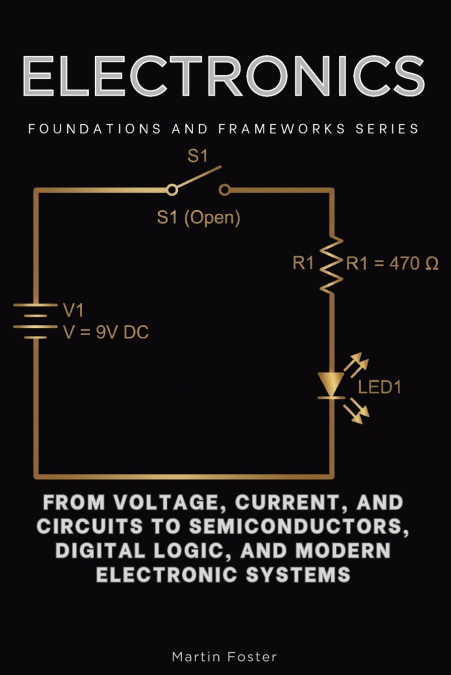
  • Electronics
    Martin Foster
    Learn electronics the way the ideas actually build on each other, with clear physical explanations, high school algebra, and worked examples using real component values. Every chapter shows what happens inside a part, then teaches you to predict how it behaves. Ten chapters run in dependency order, so each one rests on the methods from the chapters before it. You learn resistan...
    Disponible

    17,09 €

  • Supercar Engineering
    Martin Foster
    Supercar engineering explained with basic algebra and real numbers from McLaren, Ferrari, Bugatti, Porsche, and Rimac. Learn how the fastest road cars accelerate, corner, brake, breathe, cool themselves, and stay stable at speeds most cars never reach. Ten chapters build on each other. The first covers force, torque, friction, and weight transfer, and the last shows how electro...
    Disponible

    17,23 €

  • Robotics, Foundations and Frameworks Series
    Martin Foster
    Robotics comes down to one loop: sense the world, work out what the readings mean, choose an action, and carry it out. This book shows you how engineers build each part of that loop, including the math of a moving arm and the AI models that now steer humanoid robots. The chapters follow the order in which problems appear when you actually try to build a robot. Each one starts w...
    Disponible

    17,09 €

  • Formula One
    Martin Foster
    Formula One makes sense once someone shows you what you are looking at. This book explains the cars, the teams, the race strategy, and the money behind modern Grand Prix racing in plain language, with no engineering background needed. The 2026-2030 regulations reset almost everything at once. A new engine formula splits power roughly evenly between combustion and electric, the ...
    Disponible

    17,15 €

  • Electrical Engineering, Foundations and Frameworks Series
    Martin Foster
    Electrical engineering explained from the ground up, starting with what electric charge actually is and ending with how a national grid balances supply and demand every second. No technical background needed to begin, and no memorized formulas you can’t apply at the end. The chapters are ordered so each idea rests on the one before it. Math appears only where it earns its plac...
    Disponible

    17,17 €

  • Climate Change, Foundations and Frameworks Series
    Martin Foster
    Climate change explained from the physics up, in plain language, with no science background assumed. Ten chapters build a working model of the climate system so you can follow the subject with confidence. Each chapter rests on the one before it, starting with sunlight arriving at the top of the atmosphere and closing with the technology and policy choices that decide how much ...
    Disponible

    17,30 €