Inicio > Artes > Cine, televisión y radio > Television > Did All My Friends Have Fun At Play? An Oral History of Romper Room
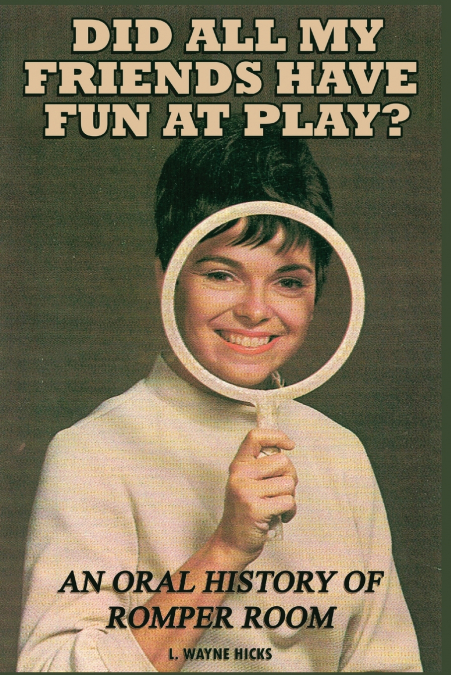
Did All My Friends Have Fun At Play? An Oral History of Romper Room

Did All My Friends Have Fun At Play? An Oral History of Romper Room

L. Wayne Hicks

36,42 €
IVA incluido
Disponible
Editorial:
BearManor Media
Año de edición:
2026
Materia
Television
ISBN:
9798905350429
36,42 €
IVA incluido
Disponible
Añadir a favoritos

Ask someone about Romper Room and they’re likely to remember only their local teacher. Miss Genie in Denver. Miss Sally in Baltimore. Miss Beverly in Chicago. Miss Molly in New York. What many former viewers don’t realize is that children in hundreds of cities across North America-and in countries around the world-were having remarkably similar experiences. Though it felt local, Romper Room was one of the most successful and far-reaching children’s television franchises ever created. Now, for the first time, the women who hosted those programs are telling their stories. In Did All My Friends Have Fun at Play?: An Oral History of Romper Room, author L. Wayne Hicks presents an unprecedented oral history built from interviews with more than 100 former Romper Room teachers. Their collective memories reveal how a local television concept grew into a global phenomenon that reached millions of preschoolers for more than four decades. From the United States and Canada to international markets where the format was adapted for local audiences, Romper Room became a worldwide brand long before most children’s television programs were distributed internationally. Yet because viewers typically knew only their local host, many never realized they were part of a much larger community of children sharing the same songs, lessons, characters, and traditions. The book explores the show’s educational philosophy, its innovative franchising model, the enduring popularity of the Magic Mirror segment, and the unique role local hosts played in shaping the childhoods of generations of viewers. More than a history of a television program, Did All My Friends Have Fun At Play? is the story of a shared childhood experience told by the women who created it every day on local television screens.L. Wayne Hicks is an award-winning writer who spent decades as a newspaper reporter and editor. He has written extensively about children’s television, including Captain Kangaroo, Sesame Street, The Electric Company, The Howdy Doody Show, Mister Rogers’ Neighborhood and Zoom. Did All My Friends Have Fun At Play? is his first book.
Artículos relacionados

  • COWBOY BEBOP
    Jeremy Mark Robinson
    C O W B O Y  B E B O P THE ANIME TV SERIES AND MOVIE by Jeremy Mark Robinson   Sex + drugs + rock music + comedy + Westerns + crime + drifter lifestyles + space battles + bars + casinos + fashion – and more music – what’s not to like in Cowboy Bebop?! – and how it wittily and cleverly mixes all of those elements, and many more.   This book focusses on the celebrated, hugely ent...
  • Women Pulitzer Playwrights
    Carolyn Casey Craig
    In the first century of the coveted Pulitzer Prizes, only 11 women have won the prize for drama: Zona Gale (1921), Susan Glaspell (1931), Zoe Akins (1935), Mary Coyle Chase (1945), Ketti Frings (1958), Beth Henley (1981), Marsha Norma (1983), Wendy Wasserstein (1989), Paula Vogel (1998), Margaret Edson (1999), and Suzan-Lori Parks (2002). This book is about them and their ...
    Disponible

    56,97 €

  • This Is a Thriller
    Alan Warren
    The late 1950s and early 1960s were the golden years of horror television. Anthology series such as Way Out and Great Ghost Tales, along with certain episodes of Twilight Zone and The Alfred Hitchcock Hour, were among the shows that consistently frightened a generation of television viewers. And perhaps the best of them all was Thriller, hosted by Boris Karloff. In Thrille...
    Disponible

    42,90 €

  • Staging Nationalism
    Kiki Gounaridou
    When a nation wants to reconnect with a sense of national identity, its cultural celebrations, including its theatre, are often tinged with nostalgia for a cultural high point in its history. Leaders often try to create a 'neo-classical' cultural identity. Artificially returning to an imagined pinnacle, however, can fail to take into account new aspects of national identity,...
    Disponible

    57,40 €

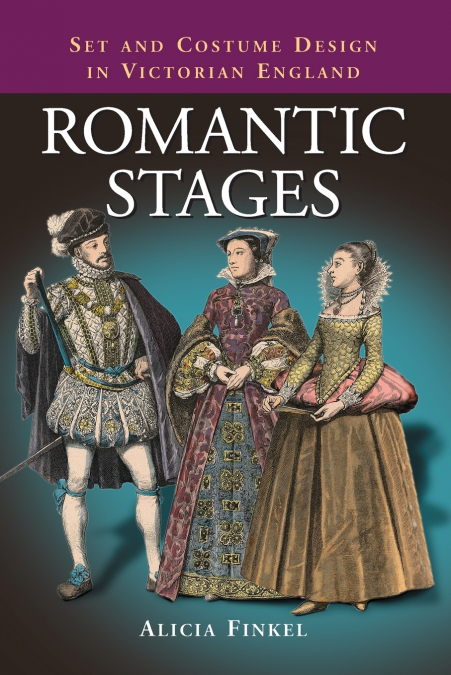
  • Romantic Stages
    Alicia Finkel
    Though Romantic elements in stage design are often thought to have ended with the advent of the Victorian era, they in fact persisted into the second half of the nineteenth century. Romantic stages were used in the productions of many of the most prominent actor-managers of the period, including Madame Vestris, Charles Kean, Wilson Barrett, Henry Irving and Herbert Beerbohm ...
    Disponible

    57,50 €

  • The HATERS’ Guide to New Who
    Mike Sivier
    '’The stories don’t work, you know.’'That’s all it took to set me off. Someone I knew - not a friend - an acquaintance had the nerve, the temerity, the-the-the audacity to tell me that the stories told in each episode of my beloved Doctor Who since the show returned to our TV screens in 2005 ... don’t stand up to scrutiny.'That is how Mike Sivier embarked on a quest to cast a c...
    Disponible

    14,46 €