Naim Tahir Baig
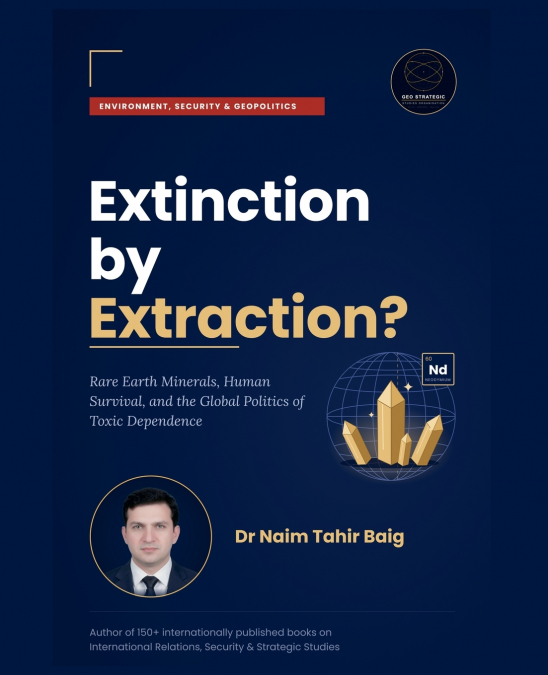
What we choose when we choose our mineralsEvery wind turbine, electric vehicle, guided missile and smartphone depends on a group of metals most people have never heard of. Rare earth elements make the modern world’s energy, defense and computing systems possible. They also come from some of the most toxic, concentrated and politically contested supply chains on Earth.Extinction by Extraction? asks a question that policy debates have largely avoided: how do the environmental and human costs of rare earth extraction interact with great-power competition to shape humanity’s long-term security? Dr Naim Tahir Baig argues that today’s order hands the benefits to a few powers while pushing irreversible harm onto the weakest places and peoples, and that diversification pursued as a security strategy, without shared governance, will relocate those harms rather than end them.Drawing on comparative case studies, policy and document analysis, and supply-chain data, the book moves from the tailings lakes of Baotou and the mines of Kachin State to the processing plants of Malaysia, the deposits of Greenland and Sweden, and the contested frontier of the deep seabed. It examines China’s dominance and the environmental debt behind it, the episodes of leverage from 2010 to the export controls of 2023 onward, and the efforts of the United States, Australia, Canada, the European Union, Japan and South Korea to build alternatives.The book uses 'extinction' in three carefully bounded senses: ecological, the loss of habitat and living systems around mining sites; communal, the displacement and disappearance of the people who live there; and civilizational, the fragility of an energy transition built on a toxic and concentrated supply chain. It does not claim that mining threatens human survival outright. It shows where the evidence is strong, where it is thin, and what is at stake in the difference.Looking ahead, it sets out four scenarios to 2040, weighs the limits of recycling, substitution and cleaner extraction, and proposes practical measures: traceability, binding shared standards, funded remediation and an honest accounting of burdens that cannot be undone.Written for scholars and students of international relations and security studies, policymakers, analysts, journalists and informed general readers, Extinction by Extraction? offers a clear and rigorous account of what the world is choosing when it chooses its minerals.