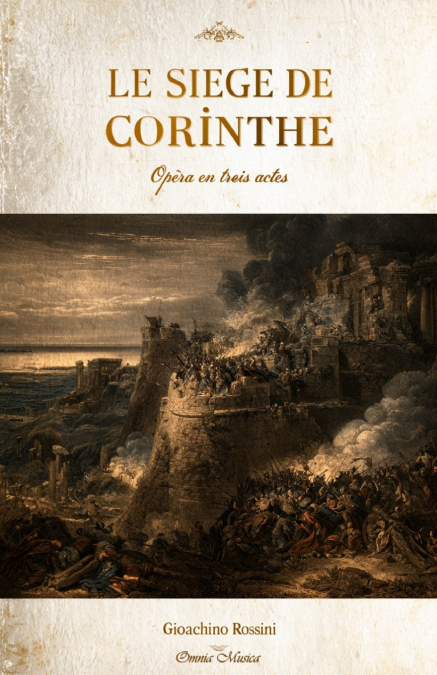
Le siège de Corinthe is a lyric tragedy in three acts by Gioachino Rossini, with a libretto by Luigi Balocchi and Alexandre Soumet, first performed in Paris in 1826. The story is set in Corinth in 1459, during the Ottoman siege led by Maometto. Cléomène, the Greek governor, urges the defenders to resist to the bitter end, whilst his daughter Pamira is secretly in love with Maometto, whom she had met in Athens under the false name of Almanzor. The young Greek officer Néoclès, Pamira’s betrothed, embodies honour and loyalty to his country. When Mohammed offers peace and marriage in exchange for surrender, Pamira finds herself torn between her love for the enemy and her duty to her father and Greece, which curses her for her betrayal.In the second and third acts, the tension reaches its peak in the catacombs, where the Greeks prepare for their final battle. Néoclès bursts into Muhammad’s tent to rescue Pamira, who pretends to be his brother. Following the Turkish victory, Muhammad once again offers peace in exchange for Pamira, but Cléomène would rather see her die than have her marry the enemy. Faced with inevitable defeat, Pamira and the Greek women take their own lives rather than fall into the hands of the invaders. The opera concludes with the destruction of Corinth in flames, a symbol of heroic sacrifice and the tragedy of war.Le siège de Corinthe est une tragédie lyrique en trois actes de Gioachino Rossini, sur un livret de Luigi Balocchi et Alexandre Soumet, créée à Paris en 1826. L’action se déroule à Corinthe en 1459, pendant le siège ottoman mené par Mahomet. Cléomène, gouverneur grec, exhorte les défenseurs à une résistance acharnée, tandis que sa fille Pamira est secrètement amoureuse de Maometto, qu’elle avait rencontré à Athènes sous le faux nom d’Almanzor. Le jeune officier grec Néoclès, fiancé de Pamira, incarne l’honneur et la fidélité à la patrie. Lorsque Mahomet propose la paix et le mariage en échange de la reddition, Pamira se retrouve déchirée entre son amour pour l’ennemi et son devoir envers son père et la Grèce, qui la maudit pour sa trahison.Dans les deuxième et troisième actes, la tension atteint son paroxysme dans les catacombes, où les Grecs se préparent à la dernière bataille. Néoclès fait irruption dans la tente de Mahomet pour sauver Pamira, qui se fait passer pour son frère. Après la victoire turque, Mahomet propose une nouvelle fois la paix en échange de Pamira, mais Cléomène préfère la voir mourir plutôt que de la voir épouser l’ennemi. Face à une défaite inévitable, Pamira et les femmes grecques se suicident pour ne pas tomber entre les mains des envahisseurs. L’opéra s’achève sur la destruction de Corinthe en flammes, symbole du sacrifice héroïque et de la tragédie de la guerre.