Len Biel
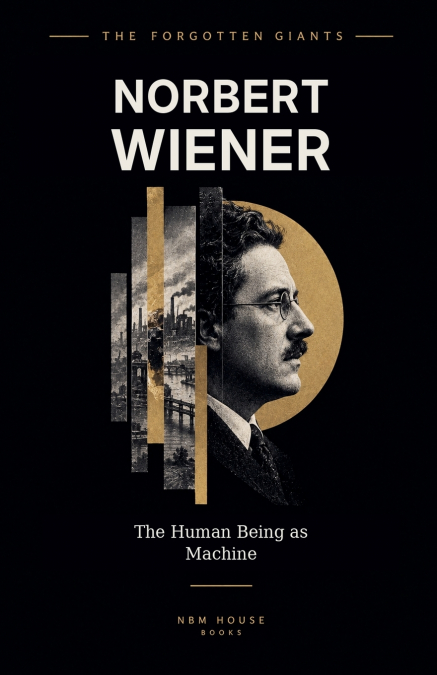
In the middle of the twentieth century, a restless mathematical prodigy named Norbert Wiener helped invent a new way of seeing the world. Out of wartime work on anti-aircraft predictors and a deep engagement with feedback, information, and control, he formulated cybernetics: the claim that the same principles governing a thermostat, a nervous system, a guided missile, and a factory could also illuminate society itself.The Human Being as Machine is not a conventional biography. It is an intellectual history that traces Wiener’s life-from the extreme educational experiment that made him a child prodigy, through the foundations of mathematics, wartime prediction, the birth of cybernetics, and his later warnings about automation and power-while continually mapping his ideas onto the present. The anti-aircraft predictor of the 1940s prefigures today’s recommendation engines and predictive models. The automated factory anticipates the algorithmic workplace. Early discussions of adaptive systems foreshadow machine learning. Wiener’s fear that society might become a vast control apparatus finds uncomfortable resonance in data-saturated platforms, information states, and self-optimizing systems.The book asks a single expanding question: What happens when we understand human beings, machines, animals, organizations, and societies as systems governed by information and feedback? If intelligence can be described as information processing and purpose as the operation of feedback loops, what remains distinctively human? Wiener never fully resolved the question. Neither does this book. It treats it as open, urgent, and now practical.Clear, rigorous, and written for both general readers and specialists, The Human Being as Machine recovers the conceptual origins of the systems that now watch, predict, and shape us-and asks what kind of beings we are becoming inside the loops we have built.