Antonios athenaeus
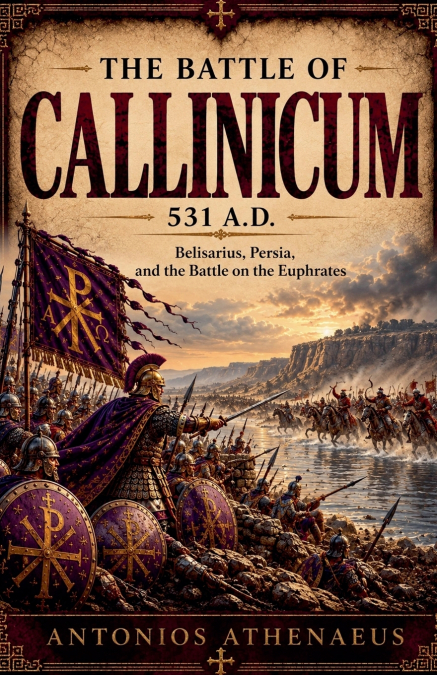
At Callinicum, Belisarius lost the battlefield-but Persia failed to turn victory into strategic success.In 531 A.D., only a year after the celebrated Roman victory at Dara, the war between Emperor Justinian’s Eastern Roman Empire and Sasanian Persia entered a dangerous new phase. Rather than attack the fortified frontier of Roman Mesopotamia, a Persian army under Azarethes, supported by the Lakhmid ruler al-Mundhir, bypassed the traditional defenses and advanced into Roman Syria. Belisarius moved to intercept the invasion, forcing the Persians to withdraw toward the Euphrates. The pursuit ended near Callinicum, where both armies turned to fight.This book examines Callinicum not simply as a defeat of Belisarius, but as a campaign shaped by mobility, coalition warfare, command, terrain, cohesion, and the relationship between tactical victory and strategic effect. The Romans depended upon cooperation between imperial infantry, cavalry, and Ghassanid allies. The Persians relied upon mounted warfare, archery, mobility, and the ability to exploit weaknesses across the open battlefield.The battle developed through mounting pressure on the Roman line. Persian horsemen contested the open ground while the Euphrates restricted Roman freedom of movement. As pressure increased on the exposed Roman flank, the cohesion of the allied sector failed. The Persians exploited the opening, the Roman mounted formations began to disintegrate, and Belisarius was left with the surviving troops fighting beside the river.Yet the Roman defeat did not become annihilation. Belisarius and the remaining defenders maintained a final resistance near the Euphrates before survivors escaped from the battlefield. Azarethes had won a clear tactical victory, but the Persian army had suffered heavily and could not transform success at Callinicum into a renewed conquest of Roman Syria. The result was one of the most revealing paradoxes of the Roman-Sasanian wars: Rome lost the battle, while Persia failed to secure the decisive strategic result its victory appeared to promise.Drawing upon ancient sources and modern military scholarship, this study reconstructs the campaign and battle through detailed analysis of:• Justinian, Kavadh I, and the struggle for the eastern frontier• Belisarius and the Roman military recovery after Dara• Azarethes, al-Mundhir, and the Persian invasion of Syria• The Eastern Roman, Sasanian, Ghassanid, and Lakhmid forces• The Persian bypass of the Mesopotamian frontier defenses• The Roman concentration and pursuit toward Callinicum• Terrain, deployment, and the tactical importance of the Euphrates• Mounted combat, archery, and pressure on the Roman flank• The collapse of the Roman cavalry and the final stand beside the river• Tactical maps, campaign maps, and battlefield diagrams• The aftermath of the battle and the road to the Eternal Peace of 532• Lessons in command, cohesion, mobility, coalition warfare, and operational decision-makingWritten for readers of military history, strategy, Byzantine warfare, and the Roman-Persian wars, The Battle of Callinicum explains how an army that had triumphed at Dara could suffer defeat only a year later-and why the Persian victors were unable to convert battlefield success into lasting strategic advantage.Callinicum was more than a reversal for Belisarius. It was a battle that exposed the limits of tactical victory itself: Rome lost the field, Persia paid heavily for winning it, and neither empire emerged with the decisive advantage it sought.