mark Smyth
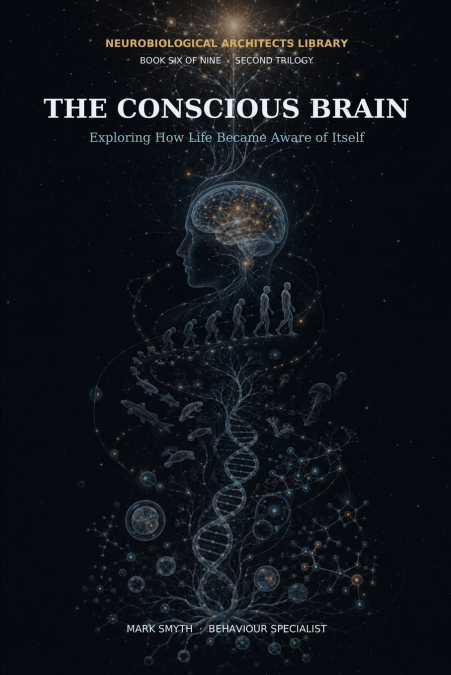
How did life become aware of itself?For billions of years, life survived without brains, thoughts or conscious experience. Single cells sensed their surroundings, maintained internal balance and adapted to changing environments. Over immense stretches of evolutionary time, these early biological processes gave rise to nervous systems, memory, prediction, social awareness and, eventually, the extraordinary human capacity to experience the world and reflect upon our own existence.In The Conscious Brain, Mark Smyth follows this remarkable journey from the earliest living chemistry to the modern human mind. Drawing on contemporary neuroscience, evolutionary biology, psychology and cognitive science, he explores how nervous systems developed, why brains learned to anticipate the future, how memories are formed and reconstructed, and how our personal histories contribute to identity and the enduring experience of being a self.The book also examines major contemporary theories of consciousness, including Global Workspace Theory, Integrated Information Theory and predictive processing. Throughout, it carefully distinguishes between what scientific evidence firmly establishes, what leading theories propose and what remains genuinely unknown.The journey ultimately reaches the most delicate boundary of all: where does the possibility of God fit? Without turning faith into neuroscience, or neuroscience into philosophy, Smyth considers what science can explain, what it cannot currently answer and why intellectual humility is essential at the edge of knowledge.Accessible without sacrificing scientific accuracy, The Conscious Brain invites parents, educators, professionals, students and curious readers to explore one of humanity’s greatest unanswered questions.Book Six of the nine-book Neurobiological Architects Library, this volume completes the second trilogy. Books One to Three trace behaviour to its biological source. Books Four to Six explore the living brain and everything that source makes possible. Books Seven to Nine help children and young people understand their own developing brains.The river has been followed upstream from behaviour to biology, from biology to consciousness and from consciousness to the boundary between knowledge and wonder.