Perumal Pugazhendhi
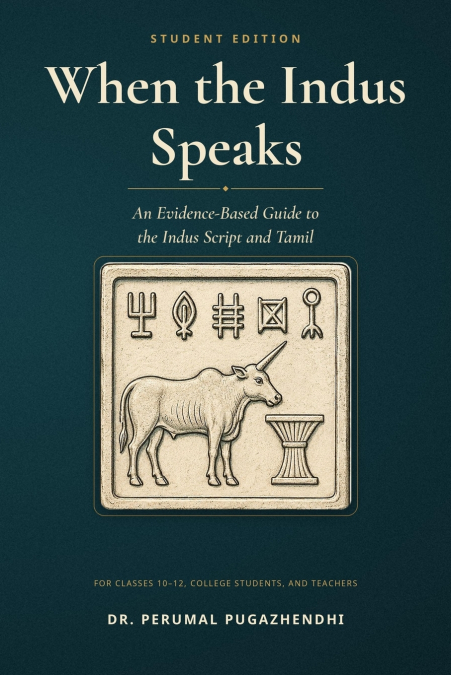
Was the language of the Harappan civilization Tamil? Many readers care deeply about that question. This book does not ask you to believe the answer. It shows you how to test the idea and judge the strength of the evidence.When the Indus Speaks: Student Edition adapts selected material from the full book, When the Indus Speaks: How Do We Test the Dravidian Hypothesis of the Indus Script? It is written for students in Classes 10 to 12, college students, teachers, and interested readers aged 15 and above. The evidence ratings for the research claims are unchanged from the full edition; learning goals, discussion questions, quizzes, and classroom activities have been added.The central question is careful and testable: the Indus signs might have recorded one or more early Dravidian languages, and words and grammatical patterns reconstructed from Tamil and other Dravidian languages may help test that possibility. The available evidence does not establish that the Harappan language was Tamil.Inside this book:The Evidence Card, with the E1-E5 scale used to rate every claimFive separate hypotheses (H1-H5): language, structure, proposed words, cultural connections, and movement and interactionA short visual introduction to Indus seals, reading direction, and twelve frequently discussed sign shapesBackground on the Harappan world, the civilization behind the signs, and the limits of the Indus corpusPart 1: The question and five hypotheses; Part 2: Understanding grammar through familiar Tamil, in four short lessons built on examples such as ūr (village); Part 3: Testing the Sembiyan Kandiyur stone axe, a six-step case study that applies four tests; Part 4: A reader’s checklist for judging any proposed Indus deciphermentEach part opens with learning goals and key terms and closes with discussion questions and a five-question self-check. Classroom activities include a shop-sign hunt for repeated word endings and a blind-matching exercise. Part 4 adds a Tamil grammar practice, an evidence-level practice with an answer key, and a final project: 'Test a claim yourself.'For teachers, the book includes a plan for four classes of about 45 minutes each, teacher notes and an answer guide, a marking guide for the final project, a glossary, suggestions for further reading, an index, and a quick-reference card.Five rules guide the book: Similarity is a starting observation, not proof of a historical link; Judge each claim on its own evidence; Decide in advance what result would count against your claim.;Apply the same standard to competing explanations.;'We do not know' is an honest conclusion when the evidence is insufficient.The classroom rule is simple: replace 'I believe it' with three questions: What is the evidence? How strong is it? What result would count against the claim?Proposed readings such as mīn?, ūr?, and nīr? keep their question marks: they are hypotheses for testing, not established translations. Concept illustrations explain ideas; they are not copies of archaeological objects.The author, Dr. Perumal Pugazhendhi, is a scientist whose work spans materials and energy research over more than forty years. A Tamil author living in the United States, he examines questions of Tamil history through evidence and testable claims, drawing on archaeology, epigraphy, and linguistics.Love for Tamil and respect for evidence can go together. This book shows students, teachers, and curious readers how.