Etienne Psaila
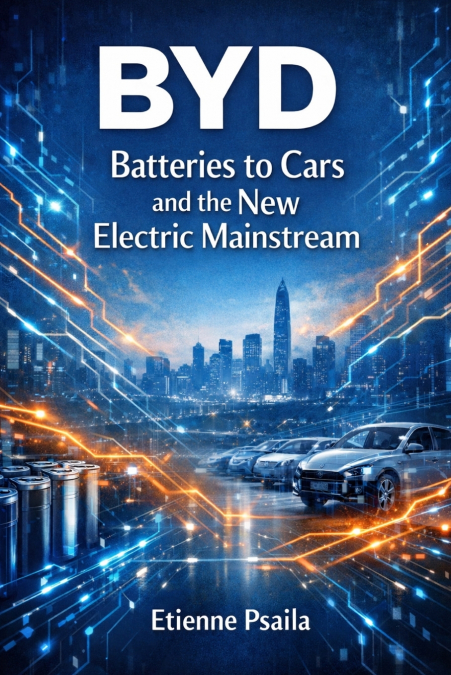
A battery company becoming a major automaker isn’t a catchy headline-it’s a blueprint for how the global car business is being rebuilt around electrification, supply security, and manufacturing scale. BYD’s rise tracks an industrial transformation that began in Shenzhen’s fast-moving, export-facing manufacturing economy and grew into one of the defining automotive stories of the 21st century: a company that learned to compete not by outsourcing the hard parts, but by owning them-cells, packs, power electronics, production methods, and the process discipline required to repeat quality at high volume.This book tells that story as a fact-driven narrative of strategy made tangible. It follows BYD from the early reality of battery manufacturing-yield, cost-down engineering, quality systems, and an unforgiving learning curve-into the far more complex world of building complete vehicles that must survive regulation, durability validation, safety scrutiny, and customer expectations across climates and markets. The transformation required more than technology; it required an organizational architecture that could translate component expertise into whole-car reliability, service readiness, and brand credibility. BYD’s path shows how vertical integration reshapes an automaker’s cost structure and risk profile, turning supply chain exposure into an engineered advantage-but also creating new pressures of complexity, governance, and execution.As EVs moved from novelty to normal, BYD became a central case study in how 'mainstream' actually happens. Mainstream is not a mood; it is volume, repeatability, and pricing power in markets that punish hesitation. It is the capacity to launch models quickly, build them consistently, and defend margins when the industry enters a price war. It is the ability to navigate trade barriers, incentive regimes, safety standards, and consumer skepticism without breaking the factory cadence. BYD’s story also makes clear that electrification doesn’t end industrial politics-it intensifies them, pushing manufacturers toward localization and forcing strategy to account for tariffs, compliance frameworks, and policy shifts alongside engineering.Written for readers who want the real mechanics behind the headlines, this is the account of how batteries became cars-and how integration, manufacturing discipline, and global expansion turned electrification into something ordinary enough to compete on price, quality, and trust. BYD did not merely join the EV era; it helped define what the electric mainstream looks like when an integrated manufacturer reaches global scale.