Etienne Psaila
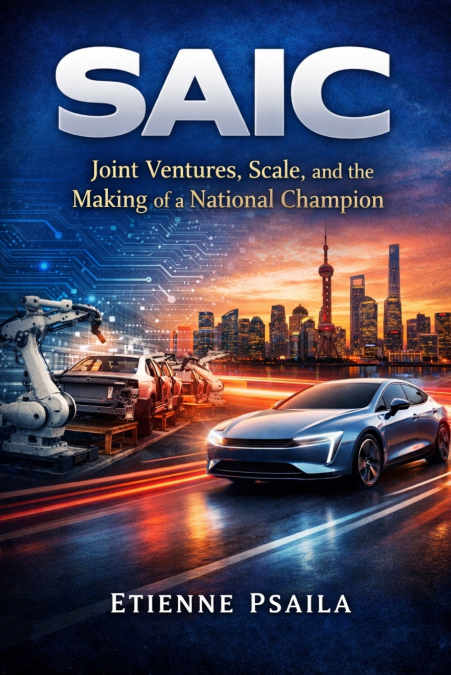
SAIC’s ascent is one of the defining industrial stories of modern China: a Shanghai-based state enterprise that learned to build at world scale by combining policy mandate, foreign partnership, and an unforgiving culture of mass production. This book follows that trajectory from the city’s early workshops and planned-economy production routines through the reform-era opening that made joint ventures not just a financing tool, but a national mechanism for capability building. In Shanghai, the logic was practical and repeatable: bring in proven platforms, insist on localization, train a workforce and supplier base to global routines, and let volume do what theory cannot-turn know-how into muscle memory.That approach made SAIC central to the template that reshaped China’s auto industry. Joint ventures with major global automakers became schools for manufacturing discipline, quality systems, supplier development, and product planning under real market pressure. The story is not told as a simple tale of 'technology transfer,' but as an operational history: how factories standardize, how vendor networks mature, how service systems and parts pipelines scale, and how corporate structures evolve when an enterprise must fund expansion, manage brands, and deliver performance in the spotlight.Scale, however, is never neutral. As SAIC grows into a multi-brand, multi-partner ecosystem-spanning mass-market mobility, mainstream passenger cars, commercial vehicles, and increasingly export-driven programs-it also inherits complexity and dependency. The book traces how SAIC builds 'SAIC-owned' identity alongside joint-venture success, how it uses acquisitions and legacy badges to accelerate product development and market credibility, and how it expands beyond China through regional strategies that demand more than shipping cars: homologation, parts support, warranty economics, and dealer competence.In the 2020s, the definition of automotive leadership changes again. Electrification, battery supply chains, software, connectivity, and fast-evolving regulation compress timelines and raise the cost of being wrong. Trade friction and intensifying global competition add new constraints to any export-led strategy, while domestic price pressure tests the economics of scale itself. SAIC’s story, told in full, reveals what 'national champion' means in practice: not a slogan, but a set of institutional capabilities-plus the strings attached to the partnerships, policies, and market realities that made those capabilities possible.