Mostafa Ebrahim
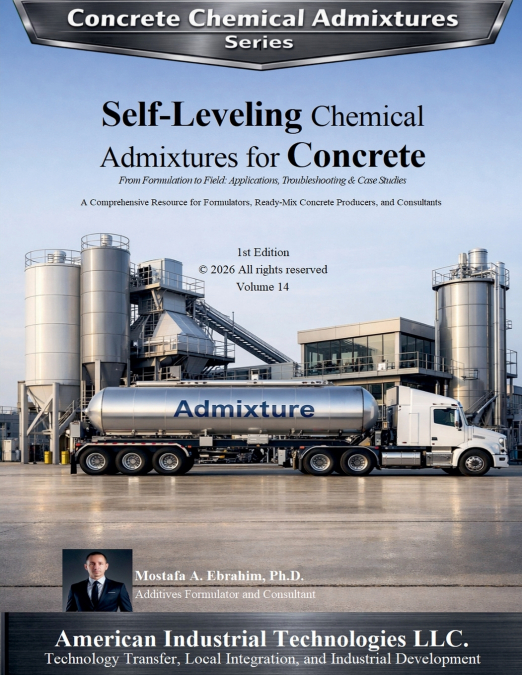
'Self-Leveling Chemical Admixtures for Concrete' presents an industry-oriented analysis of the chemistry, formulation architecture, and performance control mechanisms governing contemporary self-leveling concrete systems. Self-leveling materials are treated as precision-engineered, low-yield-stress cementitious systems in which rheology, setting kinetics, surface integrity, and early-age stability must be balanced within exceptionally narrow operating windows. The narrative emphasizes the coupled behavior of chemical admixtures, demonstrating how dispersants, viscosity modifiers, set regulators, air-control agents, and polymers interact to control flow initiation, leveling dynamics, segregation resistance, and surface quality across flooring, overlay, repair, and industrial topping applications.Authored by Dr. Mostafa A. Ebrahim, Volume 14 translates advanced polymer chemistry and colloid science into formulation strategies that are directly transferable from laboratory development to pilot validation and industrial manufacturing. Comprehensive coverage includes polycarboxylate ether molecular architecture, viscosity-modifying systems, set-control technologies, air management, shrinkage mitigation, and polymer modification, integrated with compatibility assessment, failure analysis, and corrective formulation design. The treatment adopts a technology transfer perspective, explicitly addressing scale-up effects, raw material variability, regulatory constraints, and the growing role of digital rheology, data analytics, and closed-loop process control aligned with Industry 4.0 manufacturing practices.Developed for formulators, admixture producers, ready-mix and dry-mix manufacturers, consultants, and advanced practitioners, the book bridges the persistent gap between theoretical rheology and field performance. It provides structured methodologies to design robust self-leveling admixture packages, diagnose and mitigate misapplication risks, and achieve consistent, high-quality results under real construction conditions. As self-leveling technologies evolve toward low-carbon binders, automated production, and performance-based specifications, this volume serves both as a technical reference and a practical guide for reliable innovation and industrial deployment.American Industrial Technologies LLC.Technology Transfer, Local Integration, and Industrial Development