Mostafa Ebrahim
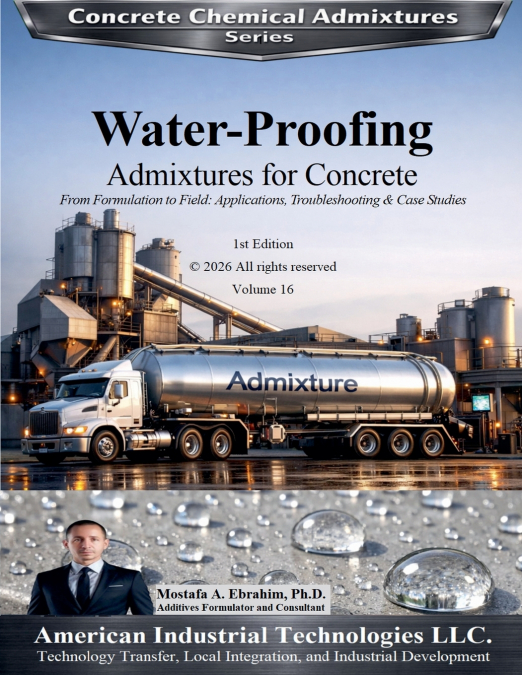
'Water-Proofing Admixtures for Concrete' is Volume 16 of the book series 'Concrete Chemical Admixtures' focuses explicitly on chemical strategies for controlling water ingress and moisture-driven deterioration in concrete, positioning waterproofing as a core performance function rather than a secondary enhancement. The volume extends the scientific and industrial foundation established in earlier titles of the series by integrating waterproofing admixtures into the broader admixture ecosystem that governs durability, service-life prediction, and structural resilience under aggressive exposure conditions.The narrative adopts a mechanistic and formulation-driven approach, moving beyond catalog-style product descriptions to examine the fundamental chemistry and physics that control water transport in cementitious systems. Cement hydration pathways, pore size distribution, and pore connectivity are treated as governing variables for liquid and vapor migration. Against this background, the text systematically analyzes hydrophobic powders, silane and siloxane technologies, crystalline growth promoters, polymer-modified systems, surfactant-based admixtures, and emerging nano-enabled approaches, with emphasis on mode of action, formulation rationale, and performance limits.A central emphasis is placed on compatibility and integration within modern concrete mixtures. The interactions between waterproofing admixtures and supplementary cementitious materials, polycarboxylate ether superplasticizers, set-modifying agents, and air-entraining systems are examined in detail, highlighting both synergistic effects and formulation risks. Industrial formulation pathways and infrastructure-focused case studies illustrate how mechanistic understanding is translated into robust, production-scale solutions capable of accommodating raw material variability, diverse construction practices, and demanding environmental exposures.Testing methodologies, quality control strategies, regulatory compliance, and sustainability considerations are addressed as integral design constraints. Standardized and performance-based permeability and absorption tests are critically reviewed, and formulation choices are linked to evolving regulatory frameworks and durability-driven sustainability metrics. By integrating material science, formulation engineering, field application experience, and digital quality assurance concepts aligned with Industry 4.0, this volume equips formulators, designers, and asset owners with the knowledge required to specify and implement concrete systems that achieve predictable, long-term water tightness and durability.American Industrial Technologies LLC.