Mostafa Ebrahim
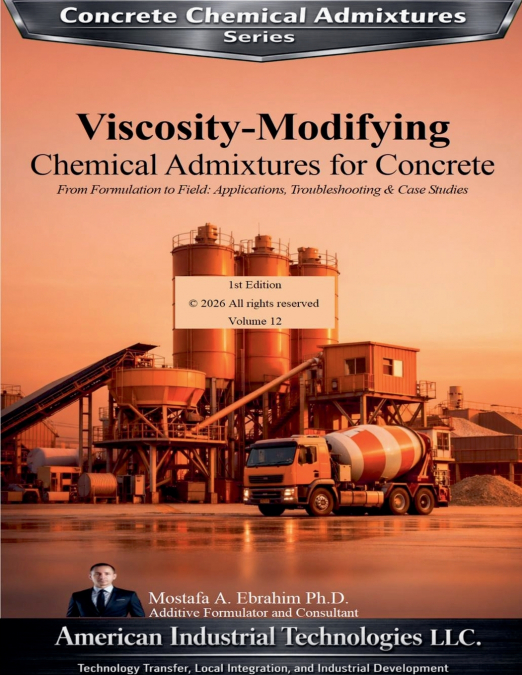
This book provides a comprehensive, industry-oriented treatment of viscosity-modifying admixtures for concrete, spanning polymer chemistry, rheological mechanisms, formulation practice, digitalization, and field deployment. It is written to bridge the persistent gap between fundamental research and reliable industrial application, with particular emphasis on variability management, robustness, and technology transfer under real production constraints.The content integrates polymer science with cement chemistry and fresh concrete rheology, explaining how molecular architecture, adsorption behavior, and water structuring translate into measurable performance in modern concrete systems. Special attention is given to complex and emerging binder technologies, including low-clinker cements, high-SCM formulations, recycled aggregates, limestone-rich systems, and carbon-mineralized binders, where viscosity control is both critical and challenging. Throughout the book, VMAs are treated not as isolated additives but as system-level enablers interacting with dispersants, fillers, environmental conditions, and processing history.A distinguishing feature of the book is its strong focus on industrial execution and Industry 4.0 integration. Digital twins, sensor-based rheology monitoring, predictive analytics, and standardized digital workflows are presented as practical tools for transforming VMAs from static formulation components into adaptive rheology control elements. Case studies trace the pathway from laboratory formulation through pilot validation to full-scale field application, highlighting common failure modes and proven mitigation strategies.The book is intended for admixture formulators, concrete producers, researchers, process engineers, and technical managers involved in high-performance and low-carbon concrete technologies. It also serves as a reference for those responsible for scale-up, quality systems, and regulatory compliance, offering structured frameworks for documentation, standardization, and knowledge retention. By combining scientific rigor with manufacturing realism, the book aims to support the confident deployment of next-generation VMAs in an increasingly automated, sustainability-driven concrete industry.